
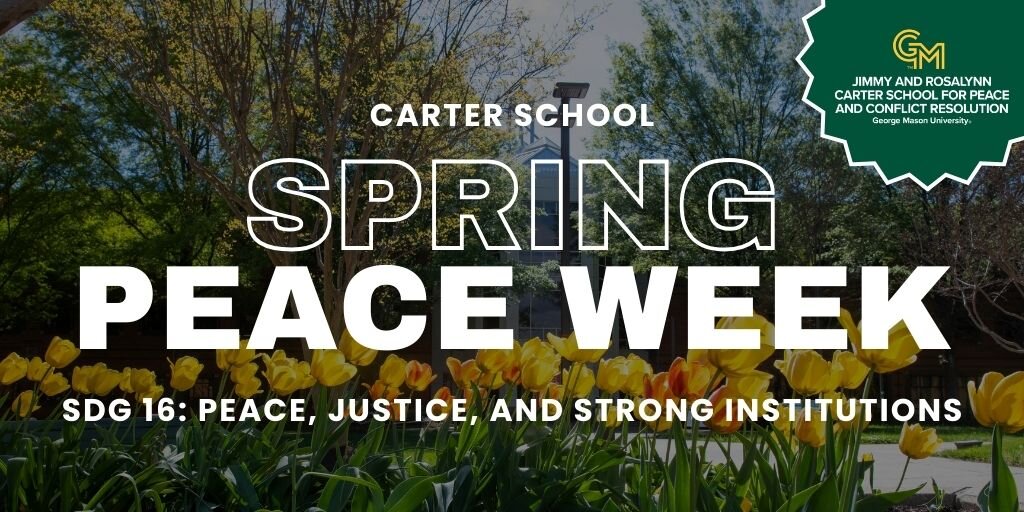
Navigating the Impact of Changes in Climate Governance on Fragile States
Thursday, April 16, 2026
12:00 PM - 01:00 PM


The landscape of global climate governance has undergone significant shifts in recent years, with profound implications for climate, relief, and recovery efforts, particularly in fragile and conflict-affected states (FCS). Traditional multilateral frameworks, such as the United Nations Framework Convention on Climate Change (UNFCCC), increasingly coexist with more fragmented, multipolar, and action-oriented governance arrangements, including regional initiatives, sector-specific regimes, and coalitions of the willing.
At the same time, the intersection of climate change, peacebuilding, and human security has gained increased attention in policy and academic debates. However, dominant narratives—particularly the framing of climate change as a “threat multiplier”—are increasingly being questioned, especially in complex conflict environments where political economy dynamics, governance capacity, and institutional constraints shape outcomes as much as climatic stressors themselves. These debates are unfolding against a backdrop of shifting geopolitical alignments, competing global crises, and, in some settings, a relative loss of political momentum and attention for climate action.
This session brings together senior scholars and practitioners to examine how recent changes in the global climate governance architecture are influencing the operationalization of climate, relief, and recovery initiatives in fragile and conflict-affected states. Particular attention is given to risk-informed decision-making, water and food security as strategic entry points, and the role of risk as both a conceptual and financial bridge linking climate impacts, peace and security considerations, and climate finance. Drawing on academic research, policy experience, and field-based insights, the session explores how evolving governance arrangements translate into concrete programming and financing decisions in fragile and conflict-affected contexts.
Session Objectives
Analyze the changing climate governance landscape:
How has climate governance evolved between COP27 and the lead-up to COP30, particularly with regard to adaptation, loss and damage, and the emergence of regional and sectoral initiatives? What are the implications of these shifts for climate-related relief and recovery efforts in fragile and conflict-affected states, especially in a context of shifting geopolitical priorities, competing crises, and a relative erosion of political impetus and attention for climate action?
Examine the climate–peace–risk nexus:
How are emerging peacebuilding frameworks, risk-based approaches, and evolving climate policy debates reshaping the integration of climate resilience, water security, and recovery in FCS? To what extent does climate change function as a threat multiplier in fragile environments, and where do alternative risk framings—incorporating governance, political economy, and systems-based perspectives—offer greater operational clarity? What complementary frameworks or analytical tools can strengthen this nexus, including through improved risk measurement, multidimensional indicators, or context-sensitive assessments?
Clarify the role of risk as a conceptual and financial bridge:
How does risk function as a key linkage and signaling mechanism between climate impacts, peace and security concerns, and financial decision-making? In what ways do risk assessments shape donor priorities, influence access to climate finance, and affect the allocation of adaptation, recovery, and loss and damage resources in fragile and conflict-affected contexts?
Identify institutional and financial gaps:
What institutional, coordination, and governance gaps persist in current climate governance frameworks for FCS? How can climate finance mechanisms—including adaptation finance, loss and damage instruments, and emerging risk-informed financing approaches—be made more accessible, flexible, and responsive to the specific constraints
Facilitated by:
- Engy Said, PhD Candidate, Carter School; Former Harvard Fellow
- Diego Osorio, PhD Candidate, Utrecht University | Adjunct Professor, École nationale d’administration publique (ENAP), Québec, Canada | Fellow (2023–2024), Harvard University Weatherhead Center for International Affairs
Speakers:
- Hans Ibbrek, Special Envoy, Climate and Security, Section for. Energy, Climate and Environment, Norwegian Ministry of Foreign Affairs
- Tatiana Miškova, Slovenian Ambassador for Water Diplomacy
- Dr. Jeff Helsing, Director of the Better Evidence Project
- Dr. Khaled El Taweel, Senior Coordinator at FAO
- Cedric de Coning, specialist in complexity theory and adaptive peace operations
Ticket Sales Ended
No tickets are available for this event.

Carter School for Peace and Conflict Resolution